The Daily Table | Charlotte Luxe Living
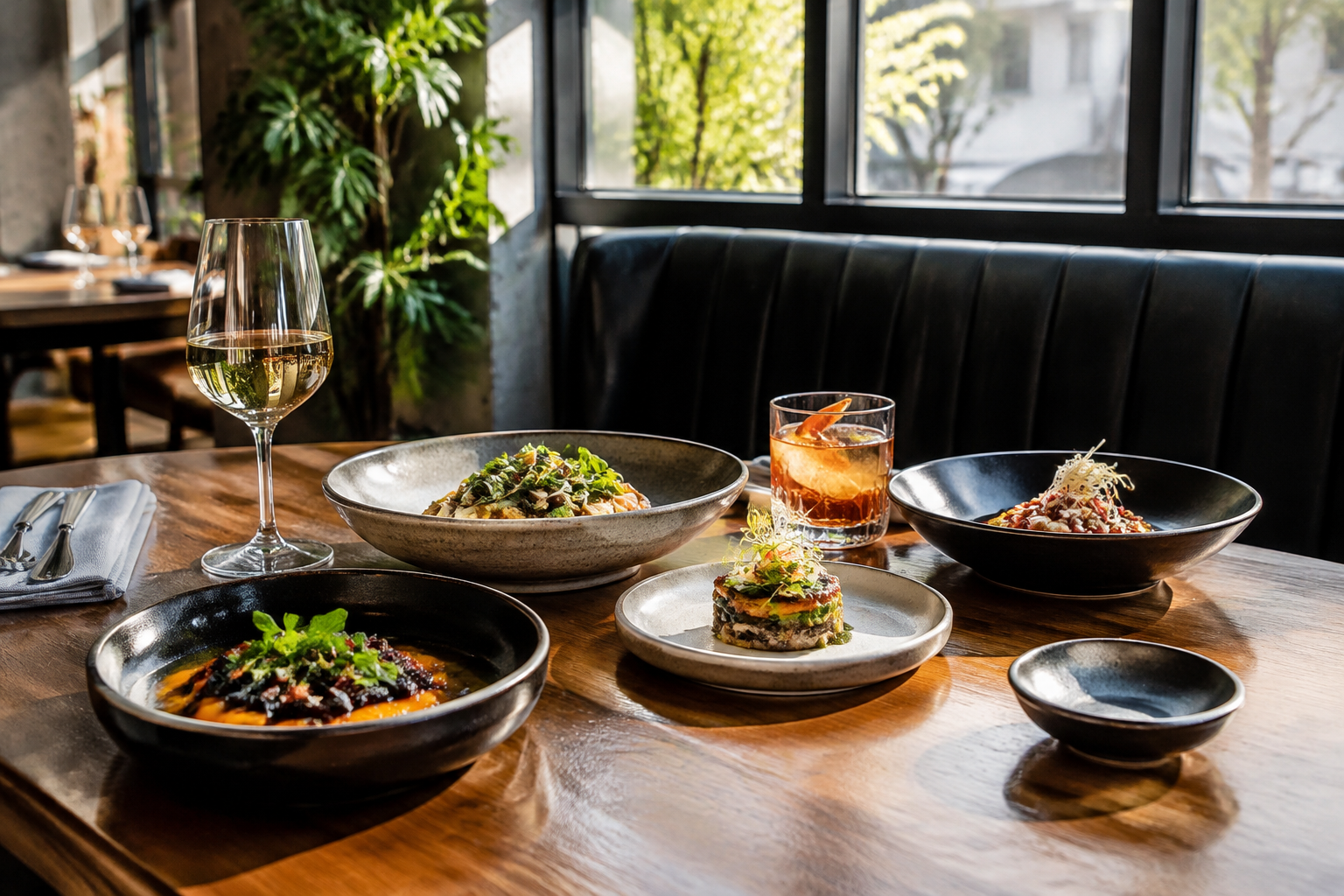
Researched editorial analysis | November 3, 2026. Customshop, at 1601 Elizabeth Avenue in Charlotte, presents a persuasive proposition: a neighborhood restaurant with enough culinary ambition to make dinner feel like an occasion, without requiring the evening to become a ceremony. Our recommendation rests on its documented menu, stated philosophy and public diner feedback—not a firsthand dining assessment.
A neighborhood address with a distinct point of view
Executive chef and owner Andres Kaifer describes a kitchen blending Latin and Italian influences with North Carolina produce. That is more revealing than the broad contemporary American category attached to the restaurant on booking platforms. The official website emphasizes Carolina purveyors and daily menu printing; the attraction is not simply that ingredients change, but that regional sourcing gives a cross-cultural menu a geographical center.
Our assessment is that Customshop makes its strongest case through that intersection. Pasta, crudo and rice provide recognizable structures, while accompaniments move beyond an exclusively Italian vocabulary. The potential weakness of such breadth is a menu that reads like several restaurants at once. Here, recurring references to corn, pork, seasonal vegetables and regional ingredients suggest a more coherent conversation.
What the menu makes worth considering
The OpenTable menu, marked updated October 28, 2026, offers a useful recent snapshot. The official website links a newer October 31 dinner menu, so the dishes and prices discussed here should be treated as planning references, not promises for a particular reservation.
Hamachi, listed at $19 with parmesan leche de tigre, red onion and crispy corn, is the clearest introduction to the kitchen’s stated identity. On paper, parmesan brings an Italian reference into a Latin preparation, rather than appearing as a decorative flourish. Wagyu beef tartare, $18, with preserved chile, black garlic, yuca and Calvander, follows a similarly layered approach. We would choose one of these opening statements rather than assume that accumulating richer starters makes a better dinner.
Vegetables deserve attention in that plan. Fall squash with caramelized onion yogurt and salsa verde, and local lettuce with cava vinaigrette, fennel, gremolata and Howard’s Gap, are each listed at $15. Their role is not merely to soften the bill: they offer a counterpoint to a menu with considerable cream, sausage, pork and cheese. That balance matters when building a meal across several courses.
The $28 middle of the menu looks especially compelling. Cavatelli combines shallot and garlic cream, fennel sausage and kale; agnolotti pairs chanterelle, ricotta and brodo. Arroz meloso brings Carolina Gold rice together with blue crab and Oishii shrimp. We would put the rice and one pasta near the center of a two-person dinner, subject to the evening’s selections and guidance on portions. These dishes appear more expressive of Customshop’s particular identity than choosing solely by the prestige of a protein.
Larger plates demand a more deliberate budget. The snapshot lists a $42 pork chop with tamal en cazuela and salsa roja, $46 halibut with Sea Island red pea, XO and parsnip, and $48 scallops with collard greens, hominy and crispy shallot. A $90 Wagyu striploin is the conspicuous splurge. Its presence does not make it the essential order; for our purposes, the pork chop’s composition makes the more distinctive editorial argument.
A bar program that belongs to the kitchen
Customshop says its seasonal, ingredient-first bar program mirrors the food. The recent cocktail listings support that claim. The Hound, $15, builds a gimlet variation around celery, local honey and Chartreuse; Dr. Feelgood, $16, combines fig-infused sour mash whiskey, acid-adjusted apple juice and ginger, with an almond warning. These are specific culinary ideas, not just seasonal names pasted onto familiar drinks.
The listed wines by the glass span $14–$22, with a mix of established and less conventional selections. We would begin with one cocktail, then ask for a wine suited to the actual dishes chosen. That is a more useful strategy than selecting a bottle before seeing a changing menu. The official $25 corkage fee per 750-milliliter bottle also makes bringing a meaningful bottle an option, though not automatically a saving.
Atmosphere and the limits of public praise
OpenTable describes the dining style as casual elegant, specifies smart casual dress and labels the restaurant lively, with moderate noise. The Michelin commentary reproduced on Tripadvisor likewise describes a convivial neighborhood atmosphere. Together, those descriptions suggest a date-night setting with social energy rather than hushed formality. We would book it for conversation and culinary curiosity, but not promise silence or secluded seating.
Recent visible OpenTable diner comments provide encouraging, specific signals. An October 24, 2026 reviewer praised a meal including cavatelli and crab-and-shrimp rice. An October 23 reviewer described helpful discussion of gluten-free options and expressed a longstanding preference for the restaurant. Another reviewer that day praised the food, cocktails and knowledgeable service while acknowledging the expense. These are individual reports, not guarantees about execution or hospitality.
On Tripadvisor, an August 2026 diner similarly praised straightforward preparation and fresh ingredients. The visible recent comments lean positive, but they do not establish a recurring complaint. Price is an explicit reservation in one recent OpenTable comment; moderate noise is a platform descriptor, not a demonstrated pattern of diner dissatisfaction. The responsible conclusion is narrower than universal acclaim: the recent accounts support enthusiasm, while leaving consistency across all tables unproven.
How we would plan the evening
We would reserve rather than build the night around a walk-in. The official site says bookings open through OpenTable 90 days ahead, including bar reservations, and warns that weekend walk-in availability is limited. Published hours are Tuesday through Saturday, 5–10 p.m. For two, a $19 starter, $15 vegetable dish, two $28 selections and two $15 cocktails total $120 before tax and gratuity at the snapshot prices; dessert and additional drinks would increase that.
The practical details reinforce its neighborhood usefulness. The restaurant identifies a free three-hour public lot across the street, another lot down Travis Avenue and Gold Line access directly in front. Families are welcome, but there is no dedicated children’s menu. Most allergies may be accommodated according to the restaurant, with an explicit exception for allium allergies; discuss requirements before booking rather than relying on a favorable review.
Our verdict: Customshop belongs on the shortlist for an Elizabeth dinner where seasonal cooking matters more than spectacle. We would book for the rice, pasta and Latin-Italian interplay, leave room for the bar’s imagination, and approach the larger proteins selectively. Its appeal is a restaurant with a discernible point of view—not an assurance that every occasion, budget or dietary need will fit.
Sources and review context
Research checked 2026-11-03. This is an editorial assessment of published information and attributed diner feedback, not an account of a personal visit. Ratings belong to their individual platforms and can change; they are not our own scores.