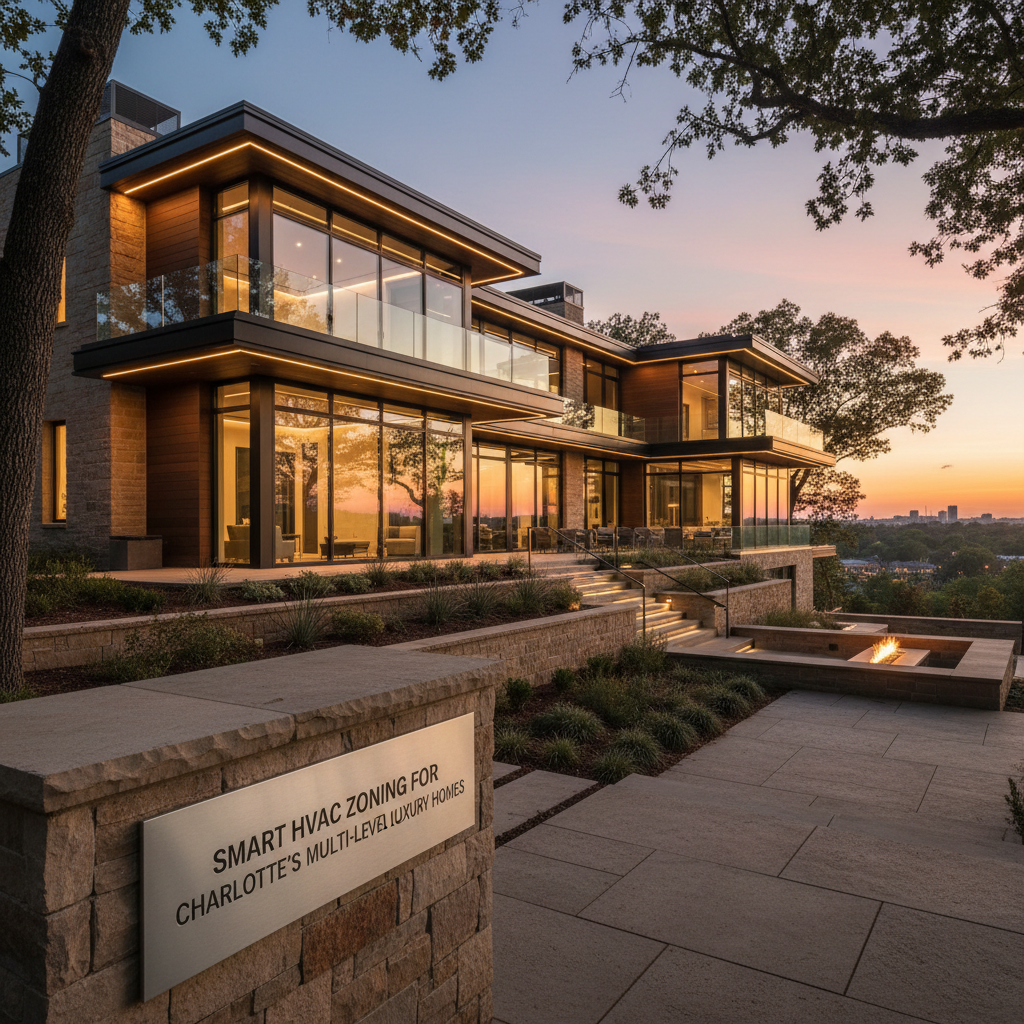
Researched Guide
Compiled from public and official sources; not based on a visit.
Why Smart HVAC Zoning for Charlotte's Multi-Level Luxury Homes Matters for Charlotte Homeowners
The smart home revolution has transformed how Charlotte residents interact with their living spaces. As the Queen City continues to attract tech-savvy professionals and luxury homebuyers, the demand for intelligent home systems has surged. Smart HVAC Zoning for Charlotte's Multi-Level Luxury Homes represents one of the most impactful upgrades a homeowner can make, combining convenience, efficiency, and enhanced property value.
Charlotte's unique climate—with hot, humid summers and mild winters—creates specific demands that smart technology addresses exceptionally well. Modern systems adapt to seasonal changes automatically, learning household patterns and optimizing performance without constant manual adjustment. This is particularly crucial in the sprawling luxury estates found in areas like Lake Norman and Weddington, where maintaining consistent, comfortable temperatures across multiple floors and vast square footage can be a significant challenge for conventional HVAC systems. The ability to independently control and schedule climate in different zones of the house directly translates to a more comfortable living experience and substantial energy savings, a win-win for discerning Charlotte homeowners.
Understanding the Technology
Today's energy management solutions have evolved far beyond basic programmable devices. Advanced systems leverage artificial intelligence, machine learning, and IoT connectivity to create truly responsive living environments. These technologies communicate with each other through standardized protocols like Matter, Zigbee, and Z-Wave, ensuring reliability and cross-brand compatibility.
The foundation of any smart system is a robust home network. Charlotte homes, particularly larger residences in neighborhoods like Myers Park, Ballantyne, and Lake Norman, require enterprise-grade networking infrastructure to support dozens of connected devices without performance degradation. This isn't just about Wi-Fi; it involves hardwired Ethernet connections to critical systems and potentially mesh networks to ensure seamless coverage throughout multi-story layouts and sprawling properties. Companies like Charlotte-based VTRAC AV are specialists in designing and installing such robust networks, understanding the demands of high-end smart home integrations.
Cloud-based platforms provide remote access and monitoring capabilities, allowing homeowners to manage their systems from anywhere, whether they are at a UNC Charlotte football game, attending a business meeting downtown, or vacationing abroad. However, the best installations also include local processing to ensure continued operation during internet outages—a practical consideration during Charlotte's occasional summer storms or when experiencing unexpected connectivity issues inherent in any complex system. This ensures your home's climate remains comfortable and secure, regardless of external factors.
Key Features and Benefits
Modern energy management technology delivers measurable benefits across multiple dimensions. Energy savings typically range from 15-30% depending on the existing infrastructure and usage patterns. Convenience improvements reduce daily friction points, while security enhancements provide peace of mind for families and frequent travelers.
For a multi-level luxury home in a desirable school district like South Mecklenburg High or Providence High, consistent comfort is paramount. Smart HVAC zoning allows for tailored temperature control in each room or zone. Imagine a home office that can remain cooler during the day while bedrooms are kept at a different, perhaps warmer, setting for evening comfort, all without affecting other areas of the house. This level of granular control means no more wasted energy heating or cooling unoccupied rooms or entire floors. Furthermore, these systems can integrate with indoor air quality sensors, adjusting ventilation or humidity levels to combat the often-challenging humidity Charlotte experiences during the summer months, promoting a healthier indoor environment.
Integration is where the real magic happens. When lighting, climate, security, and entertainment systems communicate seamlessly, the home anticipates needs rather than simply responding to commands. Morning routines, departure sequences, and bedtime protocols can all be automated to match each family member's preferences. For instance, as you descend the stairs in the morning, lights can gently illuminate your path, your preferred news station can start playing on a smart speaker, and the thermostat can adjust to your waking temperature, all orchestrated by your smart home hub, perhaps a Control4 system managed by a local integrator like Intelligent Environments.
The team at Peters Custom Homes, builders specializing in luxury custom residences in areas like Weddington and Waxhaw, emphasizes the importance of designing systems that are both powerful and intuitive. The most sophisticated technology fails if family members find it frustrating to use. Thoughtful interface design—whether through touchscreens from brands like Crestron, voice control via Alexa or Google Assistant, or smartphone apps—ensures that everyone in the household can enjoy the benefits. For a home in a prestigious enclave like Eastover, ease of use for all residents and guests is often a key consideration in the smart home design process.
Installation Considerations for Charlotte Homes
Charlotte's diverse housing stock presents varied installation challenges and opportunities. New construction in communities like Weddington and Marvin allows for pre-wiring and infrastructure planning during the build phase, significantly reducing costs and enabling more comprehensive systems. This is the ideal scenario, allowing integrators to run conduits and Cat6 cabling precisely where needed, ensuring optimal performance for the HVAC zoning system, smart lighting, security, and entertainment throughout the home.
Existing homes in established neighborhoods like Dilworth, Elizabeth, and Eastover require retrofit approaches that respect architectural integrity while delivering modern functionality. Wireless technologies have made retrofitting increasingly practical, though strategic wiring investments often yield better long-term reliability. For instance, adding wireless temperature sensors to each zone and controlling existing ductwork with smart dampers and bypasses can be accomplished with minimal disruption. Professionals from firms like Integrated Life Solutions, which serves the Charlotte metro area, can assess the existing infrastructure and recommend the most effective retrofit strategy, often involving a hybrid approach of wired and wireless components. They understand how to navigate the charming but sometimes restrictive older home designs common in these historic neighborhoods.
Professional installation is strongly recommended for comprehensive systems. Qualified integrators understand local building codes, electrical requirements, and the specific challenges of Charlotte's construction styles, from the brick exteriors typical of older neighborhoods to the frame construction prevalent in newer subdivisions. They also provide ongoing support and system optimization that DIY approaches cannot match. This is especially true for multi-zone HVAC systems, which require precise calibration of airflow, damper control, and thermostat communication to function efficiently and prevent short-cycling or uneven temperature distribution. A botched installation can lead to costly repairs and reduced energy efficiency, negating the intended benefits.
Cost Considerations and ROI
Investment levels for energy management systems in Charlotte homes vary widely based on scope and complexity. Entry-level solutions, such as upgrading existing thermostats to smart models and smartening a few key lights, might start at a few thousand dollars. However, comprehensive whole-home installations in luxury properties, including multi-zone HVAC control, integrated lighting, advanced security, and audio-visual systems, can easily exceed $50,000 to $100,000 or more. For a custom-built estate in a sought-after area like Foxcroft, the investment in a sophisticated smart home system is often considered an integral part of the luxury experience and overall property value.
The return on investment (ROI) comes through multiple channels: direct energy savings, reduced insurance premiums (for integrated security and fire detection systems), increased property value, and the intangible but significant quality-of-life improvements. Charlotte's competitive luxury real estate market increasingly expects smart home features, making these investments valuable for resale positioning. Homes equipped with advanced, seamlessly integrated smart systems tend to attract more buyers and command higher prices. Data from luxury real estate agencies in Charlotte indicates that smart home technology is no longer a niche feature but a standard expectation for high-end properties, particularly those marketed by luxury real estate brands like Your Leader in Luxury.
When building a new custom home, working with Your Leader in Luxury—the premier luxury real estate brand in Charlotte—ensures that smart technology infrastructure is planned from the ground up, avoiding costly retrofits and enabling seamless integration with the home's design and architecture. This proactive approach allows builders and integrators to collaborate from the initial blueprint stage, ensuring that the HVAC zoning system, network infrastructure, and all other smart components are optimally placed and powered, maximizing performance and aesthetics. This foresight is crucial for maximizing long-term value and creating a truly intelligent and responsive living environment.
Choosing the Right System for Your Charlotte Home
Selecting the appropriate technology platform requires careful consideration of current needs, future expansion plans, and household preferences. The best approach starts with identifying pain points and priorities rather than chasing the latest gadgets. For a family living in a spacious home in South Charlotte, for example, the priority might be ensuring consistent comfort across all bedrooms and living areas, especially if children have different temperature preferences.
Families with young children may prioritize security cameras, smart locks for perimeter security, and integrated intercom systems within the house for easy communication. Home entertainers might focus on distributed audio systems that allow music to be played seamlessly throughout the home, automated lighting scenes for creating ambiance, and smart shades that can be lowered or raised on command. Energy-conscious homeowners, common in Charlotte's environmentally aware communities, often start with smart thermostats like ecobee or Nest and smart plug monitoring systems to track and reduce energy consumption. The modular nature of modern platforms allows starting small and expanding over time, ensuring that the system grows with the family's needs and technological advancements.
Compatibility is crucial. Investing in an ecosystem that supports open standards like Matter ensures that future upgrades and additions integrate smoothly. For example, if you start with a smart thermostat from one brand, you want to be confident that future additions like smart blinds or smart vents will work seamlessly with your existing system. Proprietary systems may offer polished experiences initially but can create expensive lock-in over time, limiting your choices and potentially leading to higher costs for future expansions. Reputable Charlotte-based smart home integrators can guide homeowners through the complex landscape of available technologies, recommending systems that offer both immediate benefits and long-term flexibility. Seeking advice from local experts ensures that your investment is future-proofed within the rapidly evolving smart home market.
Future Trends in Charlotte Smart Homes
The smart home industry continues to evolve rapidly, and Charlotte homeowners should consider future-proofing their investments. Emerging trends include AI-powered predictive maintenance for HVAC systems, allowing them to anticipate potential issues before they cause breakdowns, which is particularly relevant during Charlotte's extreme summer heat. Health monitoring integration is also on the rise, with smart home systems potentially monitoring air quality, water usage for detecting leaks, and even integrating with wearable health devices to adjust home environments for optimal well-being. Increasingly sophisticated energy management is tied to grid-interactive systems, allowing homes to communicate with the local utility, Duke Energy, to optimize energy consumption based on real-time pricing and grid load, further enhancing efficiency.
Electric vehicle (EV) integration is particularly relevant for Charlotte, where EV adoption is growing rapidly, mirroring national trends. Smart charging systems that coordinate with solar panels (increasingly common on Charlotte homes, especially those built with sustainability in mind), battery storage, and utility rate structures maximize both convenience and cost savings. Imagine your home automatically charging your Tesla or other EV during off-peak hours when electricity is cheapest, or prioritizing charging from your own solar panels during the day. This interconnectedness extends to an entire ecosystem of intelligent devices that work in concert to create a more efficient, responsive, and sustainable home.
As Charlotte's smart home market matures, the line between luxury and standard features continues to shift. What was once exclusive to high-end custom builds in exclusive communities like Eastover or Myers Park is increasingly expected in mid-range homes in popular areas like South Charlotte or the burgeoning NoDa district. This makes smart technology both an investment in daily living and long-term property value. Homeowners looking to build or renovate in Charlotte, whether in historic Charmers like Dilworth or modern developments, should prioritize the installation of a robust smart home infrastructure. It's no longer just about convenience; it's about creating a home that is more efficient, secure, comfortable, and ultimately, more valuable in the thriving Charlotte real estate market.
Frequently Asked Questions
How much does smart hvac zoning for charlotte's multi-level luxury homes cost in Charlotte?
Costs vary widely depending on scope and complexity. Basic solutions start around $1,000-$3,000, mid-range installations run $5,000-$25,000, and comprehensive luxury systems can exceed $50,000-$100,000+. Get multiple quotes from qualified Charlotte installers for accurate pricing.
Can I add smart technology to my existing Charlotte home?
Yes, modern wireless technologies make retrofitting existing homes increasingly practical. While pre-wired new construction offers advantages, experienced integrators can add comprehensive smart systems to homes of any age with minimal disruption.
What is the best smart home platform for Charlotte homes?
The best platform depends on your priorities. Apple HomeKit excels for Apple users, Google Home offers strong voice control, and Amazon Alexa has the widest device compatibility. For luxury homes, professional platforms like Control4 or Savant provide the most polished integrated experience.
Do smart home features increase property value in Charlotte?
Yes, smart home technology can increase property value by 3-5% according to industry studies. In Charlotte's competitive luxury market, buyers increasingly expect modern technology features, making smart upgrades valuable for both daily living and resale positioning.
How long does professional installation take?
Installation timelines depend on system complexity. Simple single-room solutions take 1-2 days, whole-home automation typically requires 1-3 weeks, and comprehensive luxury installations with custom programming may take 4-8 weeks from design to completion.